
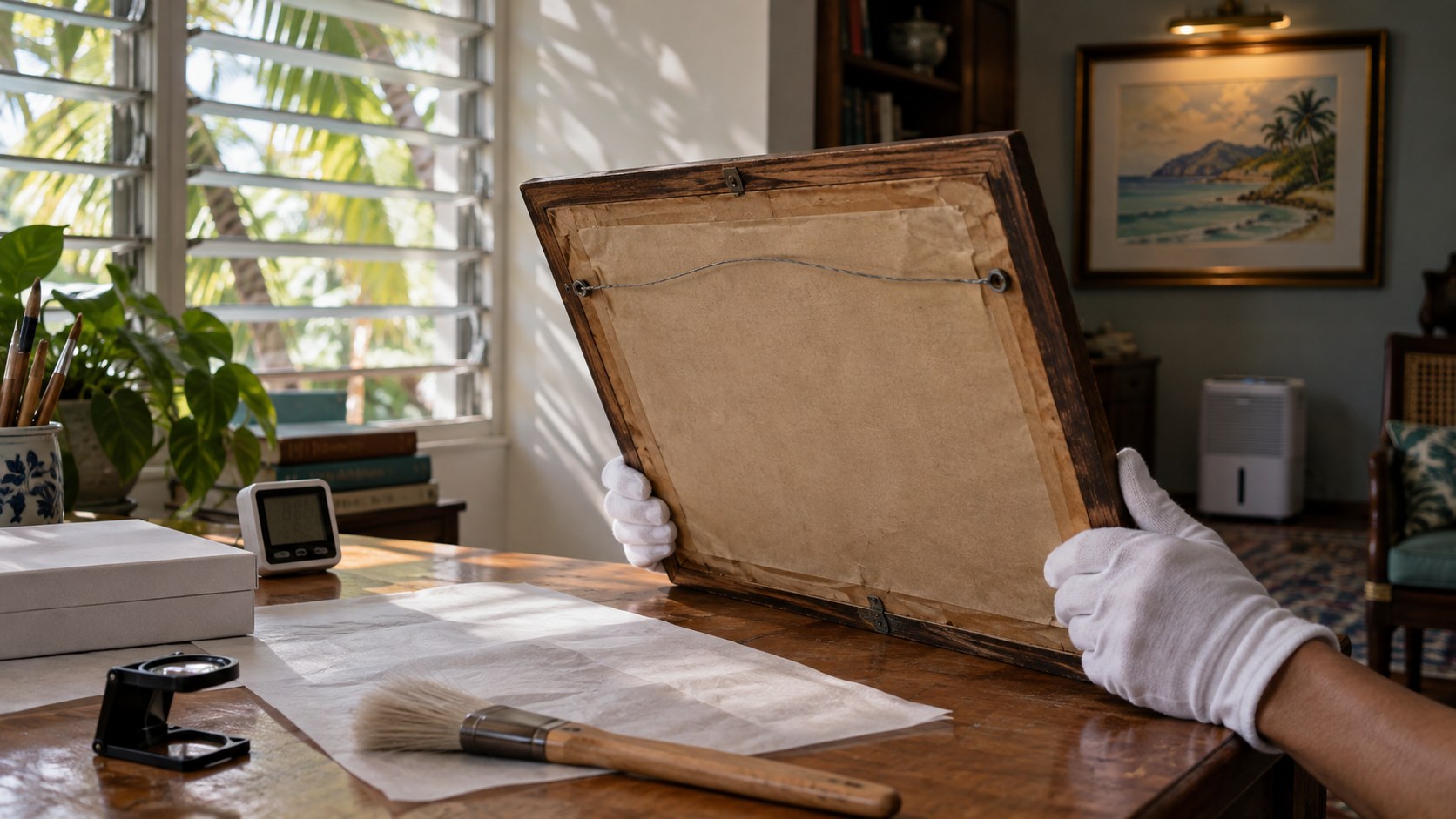

Everyone talks about humidity. The real enemy is moisture, and in the Caribbean it is only part of a larger picture: the most damaging effects on watercolours come from temperature instability, exposure to light, and how a piece is placed and stored. Here is what that distinction means for a Trinidad (or wider Caribbean) collector, and how to keep a watercolour on your wall in pristine condition for the rest of your life.
Looking for a watercolour to hang? Browse our original watercolor paintings for sale by Trinidad and Tobago artists, each one of one with a Certificate of Authenticity.
Humidity is not the problem. Moisture, driven by temperature swings, is.
If you Google how to protect a watercolour, every result tells you to control humidity. That is true, but it hides the more important word. In my years of experience, temperature control is what actually determines whether a watercolour survives in a Caribbean environment. Our tropical climate makes temperature swings hard to avoid, and the effect on art can be dramatic. Even artists face this. When temperature shifts, watercolours stored behind glass can develop condensation, and if the piece is not stored or framed correctly, that moisture is what causes the damage.
Last but not least is placement and storage. This alone can determine the lifespan of a watercolour piece.
In my years of experience, the pieces I have seen come in ruined are almost never ruined by ambient humidity. They are ruined by moisture: temperature swings in a tropical climate, a leak, a wall that sweats, an AC unit that drips, a piece stored flat against cardboard under a house. UV exposure is a major factor too, though it works differently: it fades a piece rather than warping or staining it.
This matters because it changes what you do about it. Chasing humidity and other factors without watching for actual damage is how a collector spends significant sums of money on framing with conservation-grade materials and museum glass, and still loses the painting to a slow drip from the ceiling. Some of these factors cause damage that is unseen and easy to overlook, even by a collector who looks at the piece every day.
Trinidad (and the wider Caribbean) climate makes this harder than in other places. Our average outdoor relative humidity sits between 77 and 86 percent year-round. Indoor spaces with jalousie louvers and open windows sit within a few percent of that. At night the temperature drops, the air holds less moisture, and indoor RH spikes toward the dew point. That baseline is high enough that any second source of water pushes a hung watercolour past the safe threshold before you notice. The rainy season pushes even more moisture into the air on top of that.
The rest of this article is what I tell clients, based on my over 30 years in this industry and the knowledge I have acquired from experience.
Where to hang it, and where never to
The single biggest mistake I see is placement. Collectors hang their most valuable watercolour in the room where the family gathers: the living room, the dining room, the space with the biggest windows and the most flattering light. This could be the worst room in a Trinidad (or Caribbean) house for a watercolour.
Watercolours belong in a prepared space: the darkest room you have. Not a closet, not a dungeon, a bedroom, a hallway, a study, somewhere with the least amount of natural light. Then you install specific lighting for the piece: not natural light, not regular household bulbs, but a fitting that filters UV. Both natural light and standard indoor lighting will bleach and fade watercolour pigment over time, often in ways that are not noticeable to the naked eye. The fading is slow, and because you look at the piece every day you will not see it. Somebody else will, when they come to visit after enough time has passed. A watercolour can be hung in a less-than-ideal space if it has to be, but that placement needs to be monitored closely and should not be permanent. UV-protective glazing helps in these situations, but it is a stopgap, not a substitute for the right room.
Two absolute rules for placement in a Trinidad home:
- Never hang a watercolour on an exterior wall. Concrete masonry walls, especially west and south-facing, absorb moisture in the wet season and release it slowly. The back of the frame is the point of failure.
- Never hang a watercolour under, over, or next to an AC unit. Not one metre away, not two. AC units in this climate condense water, and eventually all of them drip. I have had one client bring the same piece back for restoration four times before the painting reached the point where nothing more could be done if it gets damaged again. Every restoration effort was successful. The fifth leak was the one that finished it. This was a very expensive piece of art she almost lost by choosing a wall space that was unsafe.
The story that made me insist on sealed frames
The worst damage I have ever seen came in a cardboard box. A local artist named Edwin Hing Wan died on February 17, 1976, and his family did not understand the value of his work. They stored a collection of his work in a cardboard box under a house for years. Trinidad houses on stumps let air, insects, moisture and everything else move freely through that space. When the collection surfaced years later, the paper had been eaten by insects, taken over by mould, and covered in the reddish-brown spots we call foxing, and major acidity had taken over the whole collection. It was the worst kind of damage a watercolour can suffer.
A collector bought the whole set and had every piece restored to its original state. The paper itself was rebuilt. The restorer brought both damaged and vanished sections back. I mention that not to romanticise the outcome but to say that even a piece that looks past saving usually is not. The process is expensive, slow, and dependent on somebody with real skill, but it exists.
That experience shaped how I now recommend framing. Every watercolour I frame gets sealed at the back. Some conservators internationally argue for a breathable package, believing the paper needs to move with the room. In Trinidad the calculation is different. Our real threat is not the paper needing to breathe. It is what walks or crawls into the frame and eats the paper. Insects get in, and either they chew the paper directly, leave droppings on the artwork, or die inside the frame and leave stains where their bodies decomposed. A sealed frame keeps them out.
Two other framing rules I do not bend on:
- Acid-free everything. The matting, the backing board, the hinges, the tape. Standard wood-pulp mats leach acid into the paper as they age, and in this humidity the reaction runs faster. Anything touching the artwork must be acid-free.
- UV-filtering glazing. Museum glass or conservation glass, both of which block 97 to 99 percent of UV radiation. It costs more. It is worth every dollar. If a client refuses UV glass, I tell them plainly that the piece must go in the dimmest room in the house, because even indoor lights will now damage it.
None of these materials are made in Trinidad. Everything conservation-grade is imported. The only piece manufactured locally is watercolour paper itself, and even that is imported in sheets, cut, and bound here. Availability is not a problem, I have never had a real supply delay, but expect to pay for the shipping in the cost of the frame.
The 24-hour panic call: “I see brown spots”
The call comes about once a month. Someone spots a reddish-brown mark on a watercolour that was fine the last time they looked. That mark is foxing, and foxing means acidity has reached the paper. Sometimes it is the mat, sometimes the backing, sometimes the wall behind the frame, sometimes moisture that carried acid from the frame packaging.
There is nothing you can do at home. Do not wipe it. Do not spray it. Do not put it in the sun to dry it out. Do not remove it from the frame yourself. Take the piece off the wall, keep it flat and dry, and bring it to a restorer. Acid removal is a chemical process that has to be done by hand, on the paper, by somebody trained. Anything you attempt in the meantime will make the damage bigger and the restoration more complex.
When it stops being a framer’s job
A framer, at least in my experience, preserves the artwork, sets it up so damage stops accumulating. A restorer, or conservator, repairs the damage that has already happened: sun bleaching, UV fading, foxing, molding, tears, water staining, and more. There is technically no watercolour that cannot be restored. Every damaged piece has a process. What varies is how many process sessions it needs and how long each takes. A minor case might be two or three weeks. A serious one might be months. The restorer will not know the full timeline until they open the piece and begin to assess the damage.
If a piece is bad enough that Trinidad-based restoration cannot handle it, or if the collector wants a specialist for a museum-grade work, the piece goes overseas. Timing and cost vary widely; expect several weeks minimum and a serious commitment. I can walk you through the decision and the referral if it comes to that.
Hurricane season, June through November
Every year, before June, do one thing: think about moisture, not weather. Storms bring water. Roofs leak. Power goes out and AC units drip once they thaw back on. Windows sweat. Any of that reaching the back of a frame is enough.
For pieces on the wall, my recommendation:
- If the room has temperature swings, run a dehumidifier during the season. That single appliance controls the moisture that would otherwise migrate through the wall or the frame.
- If a dehumidifier is not an option, wrap pieces you can take down in acid-free tissue paper. Tissue absorbs moisture and gives the paper somewhere to release it that is not itself.
- Store loose or unframed watercolours in individual plastic sleeves so they cannot press against one another.
- Check every piece, framed and stored, every four to six weeks. The reason clients do not notice damage is because they look at the piece every day. Fresh eyes see the change.
The myth that drives me the craziest
Collectors and artists both believe that placement and storage do not matter much in our environment. That belief costs them their paintings. Clients who place a piece on a wall with an AC unit, uncontrolled moisture, or direct sunlight and indoor lighting usually never see the effects building up: even though they are in the room with the piece every day, the naked eye cannot catch gradual damage in progress.
The client who put her watercolour under the AC unit and lost it after four restorations believed the same thing. Every day she looked at it and did not notice the gradual bleaching, the softening of the paper, the tiny stains forming from the drips. She noticed when we took it out of the frame to redo it, and by then the paper had shifted into damage that no restorer could reverse. If somebody had walked into her house one year in and said move it, she would still have the piece.
Artists are not exempt either. Pieces stored in a cupboard or in boxes piled on each other, with no thought to the long-term effects, usually end up discarded once the cost of paper restoration is weighed against the work’s value. Nothing is beyond repair, but repair has a cost, and prevention is cheaper every time.
Look at your walls this week. If any of your watercolours are near an AC unit, in direct sun, on an exterior wall, or in the brightest room in the house, it is in your best interest to assess them and move them to a safer space for conservation.
Frequently asked questions
Does museum glass really protect against humidity?
No. Museum glass filters UV and reduces reflection. It does nothing about moisture on the back of the frame. Humidity protection comes from the sealed frame package, acid-free materials, and the room you hang the piece in.
Can I use silica gel packets inside the frame?
Not as a solution. Silica gel saturates within days in this climate and becomes worse than nothing. A dehumidifier in the room is the reliable answer.
Is a painting stored flat safer than a painting on the wall?
Storing an unframed painting flat is safe once it is sealed in plastic, kept away from anything acidic, and stored in a controlled environment. A framed painting on the wall is fairly safe once the space meets the same requirements already covered here: away from direct light, away from moisture sources, in a stable environment. Flat storage only wins if the storage environment is dryer than the wall. A watercolour in a cardboard box under a Trinidad house is far worse than the same piece hung in a bedroom.
How often should a framed watercolour be reframed?
If it was framed correctly with acid-free materials, sealed, and UV glass, you should not need to reframe for decades. If any of those are wrong, sooner rather than later.
Can I remove foxing myself with hydrogen peroxide?
No. You can bleach the paper, thin the pigment, or trigger reactions with residual acid. Foxing removal is a professional job.
What to do next
If you are about to buy a watercolour, examine the piece for any signs of past bad storage, placement, or exposure damage before you commit. If you already own one and are not sure how it is framed, reach out to Sea Sand Art Source for a consultation. You can bring it in or send us a photo of both the front and back of the frame. Ninety percent of what goes wrong is decided before the piece ever reaches your wall. The other ten percent is placement, and that is the easiest thing to fix.
You can see the originals we currently have, get a framing estimate through the Frame Vue tool, or read our companion article on how to authenticate original Caribbean art.
Sandy Maraj has worked in framing, restoration, and conservation in Trinidad for the past 30 years. She runs Sea Sand Art Source with her business partner Servaughn, based in San Fernando. Her expertise came the way most framing expertise comes: hands-on, working with restorers and conservators over three decades, learning from the pieces that made it and the ones that did not.
Source note: Climate baselines cited from the Trinidad and Tobago Meteorological Service. Conservation science drawn from the Canadian Conservation Institute’s guidance on caring for paper objects.