
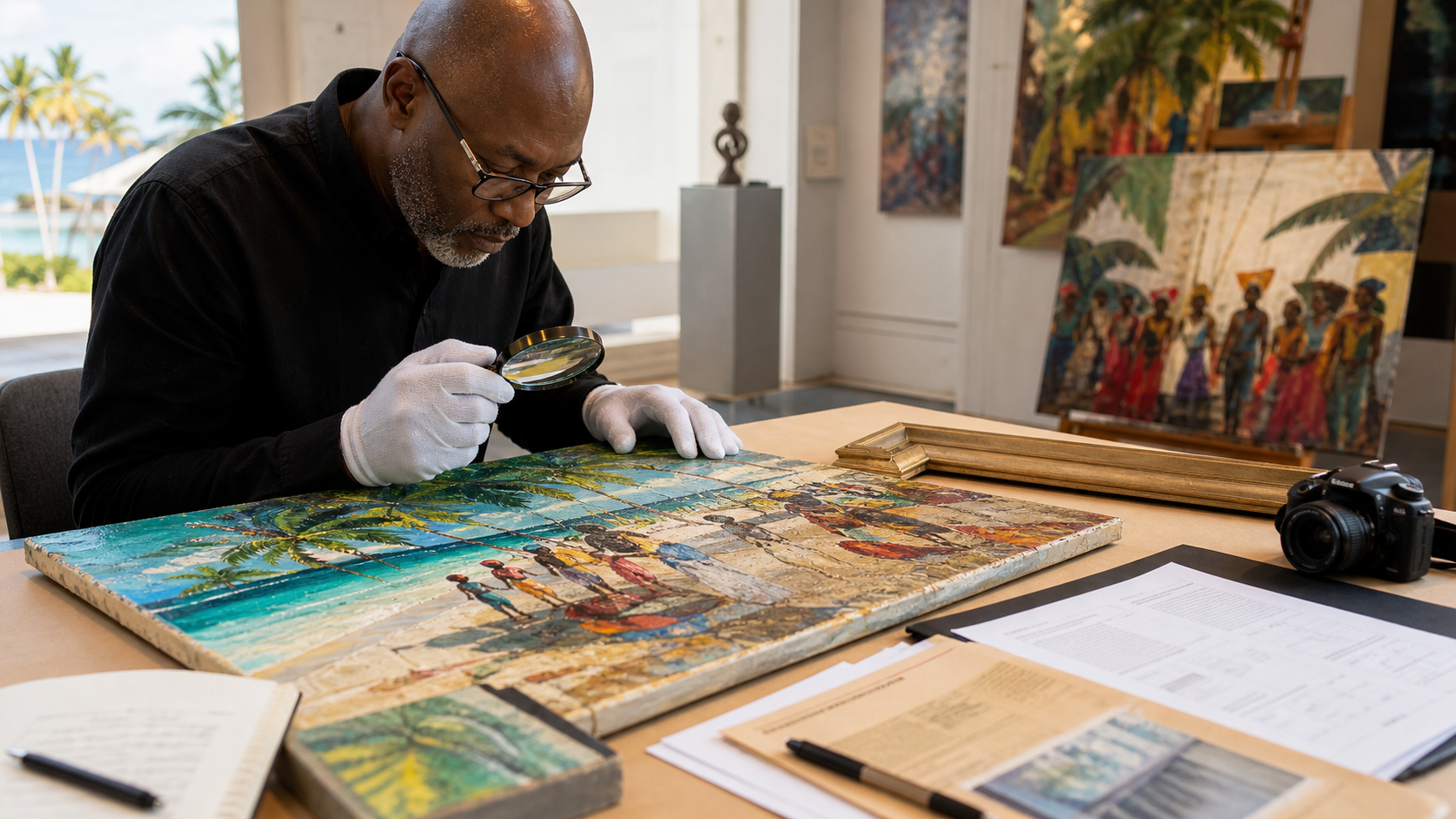

A guide to buying original Caribbean art without ending up with a fake, from a gallery that has authenticated work for thirty years.
A collector approached me some years ago to build an exhibition around a piece he had acquired from a well-known Trinidad artist. When I examined the work up close, something was wrong. The materials looked too new for the era the artist supposedly worked in. The surface, the canvas, the ageing, none of it belonged where it claimed to be. I told him I would not proceed with the exhibition. He went on to sell the piece himself, to someone who did not ask the questions I asked.
That is how the fake-art trade in the Caribbean works. It moves quietly, through people who trust the wrong sources and never think to open the back of a frame.
This article is what I would tell you if we were sitting across from each other at Sea Sand Art Source, deciding whether the painting in front of us is what someone says it is. It is not legal advice. It is practical judgment from thirty years of handling Caribbean and international art, framing it, sourcing it, cataloguing it, and turning some pieces away.
Why Caribbean art is a target
The Caribbean contemporary market is small, tightly connected, and rich in named artists whose work has real resale value. That combination invites fraud. Local painters like Boscoe Holder, LeRoy Clarke, and Michel-Jean Cazabon have been forged or misattributed. Estate sales get mixed with pieces of uncertain origin. “Family heirlooms” surface in inheritances with no paperwork at all.
Most fakes are not sophisticated. They rely on the buyer wanting the piece to be real, on nobody physically examining it, and on the seller sounding confident. Once you know what to look for, most misattributions stop being subtle.
The three questions to ask before you buy
Before money changes hands, get honest answers to three questions:
- Where did this piece come from? Direct from the artist, from a gallery of record, from an estate, from another collector, or from an unknown source? Each has a different level of risk. A living artist can confirm their own work with a phone call. An estate should have records. An unknown source is a red flag until proven otherwise.
- What paperwork comes with it? A Certificate of Authenticity from the artist or their estate. A bill of sale from the original transaction if it exists. Exhibition history. Any published record, catalogue, book, article, that mentions the work by name. Not every piece has all of this. But every piece should have something.
- Can the piece be physically examined out of its frame? If the seller refuses, walk away. There is no legitimate reason to prevent an inspection of the canvas, the stretcher, the backing, or the reverse of the work.
A work must never be authenticated by just looking at it in a frame. Work can be processed to look aged at first glance, and even at a second glance.
What we look for at Sea Sand Art Source
When a piece comes into our gallery, whether from an artist we are considering representing, from a collector who wants us to help them sell, or from someone bringing in an inherited work for framing or restoration, there is a process. It is not paranoid. It is what thirty years of handling art teaches you.
1. Age of the materials
The first thing I notice is the age of what the work is made from. Canvas, stretcher bars, staples, tacks, backing paper, varnish, paint layers, each of these ages in a specific way. A piece attributed to an artist working in the 1960s should not be built on materials that came out of a hardware store in 2019. This is the single most common tell in Caribbean forgery.
Old canvas has a specific weave and yellowing pattern. Stretcher bars from the mid-twentieth century use different joinery from what modern factories produce. Staples versus tacks tell you a period. Varnish oxidises predictably over decades. When materials do not match the era claimed, that is your answer.
2. The reverse side
Half the story of a painting is on the back. Old gallery labels, previous owner inscriptions, dealer stamps, exhibition tags, framer’s marks, these accumulate over a work’s lifetime and are almost impossible to fake convincingly. A blank, clean back on a piece that is supposed to be sixty years old is suspicious.
I have unframed pieces during routine framing jobs and discovered things that changed my view of a work’s age or origin entirely. Fresh construction under an aged frame. Signatures that look painted rather than signed. Canvas edges that were never actually stretched around bars. You cannot see any of this through the front of a glass frame.
3. Signature and technique
Every artist has a way of signing that becomes consistent over time, slant, pressure, letter formation, position on the canvas. Compare the signature on the piece in question to signed works from documented sources. Auction catalogues, museum records, and the artist’s own published work are your references. Forged signatures are usually painted rather than confidently drawn, and they hesitate where an authentic signature flows.
The same principle applies to brushwork. Every artist develops a physical vocabulary, how they load a brush, how they layer, how they resolve edges. A studied forgery can mimic these superficially, but under close examination the energy is wrong. Real work has decisions in it. Forgeries have imitations of decisions.
4. Provenance chain
Where has this piece been, and who has owned it? A strong provenance is a paper trail: bill of sale, transfer of ownership, exhibition history, gallery records, publication citations. The chain should be continuous or the gaps should be explainable. A piece with no history before it appeared in someone’s possession five years ago is a piece with a problem, until you can explain the missing decades.
Certificates of Authenticity, what they mean and do not mean
A Certificate of Authenticity, or COA, is a document that identifies a specific artwork and states that it is what it claims to be. A proper COA includes the artist’s name, the work’s title, medium, dimensions, year of creation, an image, the signatory (usually the artist, the artist’s estate, or a recognised authenticator), and a date.
A COA alone is not proof of authenticity. A COA from the artist themselves is strong evidence. A COA from a random seller is not. A COA on unheaded paper, without a photograph of the work, without a signatory whose authority can be verified, that is a document, not an authentication.
At Sea Sand Art Source, our position is straightforward. Every living artist we represent provides their own COA for their own works. For pieces where the artist has passed away or cannot provide certification themselves, we can issue an SSA Certificate of Authenticity based on our own examination and documented provenance. But the standard we hold ourselves to is that a living artist should always be the primary source of their own authentication, and when we represent a living artist, we know them personally.
Buying from a living artist, the safest path
For contemporary Caribbean art, the safest purchase you can make is one where the artist is alive, reachable, and can confirm their own work directly. That is the entire model at Sea Sand Art Source. Every artist we represent is a living contemporary artist. We have met each one. We have seen their studio, their process, or documentation of it. We have photographs of them with the works they have consigned to us. Each piece has been vetted before it appears on the site.
When we take on a new artist, they submit their bio, a headshot, their artist statement, and samples of their work for our review, especially if they are new or not widely recognised. We have a conversation. We look at the work. We assess whether we can represent them well, and whether they are ready to be represented. Most artists we speak to become part of the roster. It is rare that we turn someone away. But we do turn people away when something does not add up.
At intake, we document each piece: title, size, medium, condition on receipt, and provenance if the piece came to us through the artist’s estate or a prior collector rather than the artist directly. When the artist cannot provide their own photography, we set up an appointment and photograph the work ourselves, usually with the artist present.
What to do if you are handed an inherited work
Clients bring in family pieces to Sea Sand Art Source with real regularity. A grandmother had a painting on the wall for fifty years. An aunt left a small collection. There is a Cazabon in the family, or one that is claimed to be. Most of the time these are exactly what they appear to be, personal pieces of moderate value, worth caring for and preserving.
Occasionally they are much more. Occasionally they are much less. The disappointment when a family piece turns out not to be by the artist the family believed is real and it is delicate. We handle those conversations directly and with respect, because misattribution in a family is usually not deceit, it is memory drifting over generations.
If you have inherited a Caribbean artwork you are unsure about, do not clean it, do not reframe it, and do not sand or repaint anything. Bring it in framed. We will examine it, discuss what it is likely to be, and if authentication requires it, we will refer you to specialists who can conduct scientific testing (UV light, infrared reflectography, pigment analysis) if the value warrants it.
Registries and industry bodies
There is an Artist Registry of Trinidad and Tobago (ARTT). It is a useful institution for career artists to join and be recognised in. For hobbyist artists it is less essential, most local visual artists work part-time and the registry is oriented toward professional practice.
The Art Society of Trinidad and Tobago (ASTT) holds most working artists as members and remains the main professional body for visual artists in the country. 101 Art Gallery, which had been an important local venue in previous decades, is no longer operating in the form it once did.
When you are researching an artist you are considering buying, ASTT membership is a positive indicator. ARTT registration adds further credibility for career artists. Absence of either is not disqualifying, many working artists do not join every body available to them, but presence of either strengthens the case.
Buying internationally, witnesses and third parties
When we work with international clients on pieces that come from sources other than the living artist, estates, resales, older collections, we recommend they arrange a trusted local witness in Trinidad to physically examine the work before purchase. Photographs and video only tell you so much. Age of materials, signature quality, and the reverse of the work require physical presence.
Sea Sand Art Source can serve this role for buyers who are not in Trinidad. When we do, we are transparent about what we can and cannot verify. We do not pretend to authenticate work by artists we have not personally handled before, and we do not sign COAs for pieces we cannot stand behind.
A buyer’s checklist
Before you buy any original artwork, from any source, walk through this list:
- Have I personally seen the work, or arranged for someone I trust to see it?
- Do I know where the piece came from and who has owned it?
- Have I received a COA that identifies this exact work, from a credible signatory?
- Have I seen the reverse of the piece (not just the front through a frame)?
- Do the materials, signature, and technique look consistent with the artist claimed?
- Can I contact the artist directly to confirm, if they are living?
- Is the price reasonable relative to the artist’s documented market? Bargains on named artists deserve suspicion.
- Am I buying from a source that would take the piece back if it were proven inauthentic?
If you cannot answer these confidently, do not buy the piece, or negotiate a written right of return contingent on independent authentication.
The Sea Sand Art Source standard
Every artist represented on this site is a living contemporary artist. Every artist has been personally verified. Every work has been photographed at intake and approved before consignment. Every work sold ships with either the artist’s own COA or, in the rare cases where that is not possible, our own certification based on documented examination.
We do this because it is the only way to sell Caribbean art with confidence, ours and yours.
To date, we have not had a client purchase a work from Sea Sand Art Source that has been questioned. That is not luck. It is the process.
Common questions
How can I authenticate a Caribbean painting I bought years ago?
Start by contacting the artist directly if they are living. If they are not, contact the estate or the artist’s known representative. If neither exists, bring the piece to a qualified gallery for physical examination. Scientific testing (UV, infrared, pigment analysis) is available for pieces whose value warrants it and can be arranged through specialist labs.
What is the difference between a print, a signed print, and an original?
An original is a one-of-a-kind work created by the artist, a painting, drawing, or sculpture that exists as a single object. A print is a reproduction (offset, giclée, or other) that may exist in unlimited or limited quantities. A signed print is a print the artist has signed to acknowledge, often numbered as part of an edition. Signed prints have value, but they are not the same as originals and should never be sold as such.
Are Certificates of Authenticity legally binding?
A COA is a warranty from the issuer. It is legally meaningful to the extent the issuer has authority to make the warranty. A COA from the artist is a personal warranty. A COA from a random dealer without evidence is largely worthless. In Trinidad & Tobago, misrepresentation in the sale of goods is actionable under general contract and consumer protection law, but litigating an art fraud is slow, expensive, and usually a poor use of time compared to prevention.
Should I get every piece I own professionally authenticated?
No. Professional authentication (scientific testing, expert opinion, catalogue raisonné inclusion) is worth the cost for high-value pieces or where insurance and estate planning require it. For most personal collections, careful documentation of provenance, clear COAs, and a relationship with a knowledgeable gallery are enough.
Can Sea Sand Art Source authenticate work I bought elsewhere?
We can examine any piece and give you our professional assessment. Formal authentication with a COA we sign is limited to works by artists we know personally or where documented provenance meets our standard. For deceased artists whose work falls outside our specialty, we can refer you to specialists who can conduct scientific testing.
What happens if a piece I bought turns out to be fake?
Depends entirely on where you bought it. Reputable galleries with return policies will refund a proven forgery. Private sellers, auction houses, and online marketplaces have varying policies, and enforcement is often difficult. This is the argument for buying from established sources with clear policies in writing.
Considering buying original Caribbean art?
Browse our roster of verified living Caribbean artists. Every work is authenticated at intake, framed in-house, and shipped with the documentation collectors need to trust what they own.
This article is written from thirty years of professional experience handling Caribbean and international art. It is not legal advice. For high-value pieces or contested authentication, consult a qualified art conservator, appraiser, or attorney.