How a Trinidad artist mentored by LeRoy Clarke came to paint a 20-by-6-foot mural on the tallest deck of the largest cruise ship ever built, and what he was really painting.
The intention behind the work
The first thing Jason Hospedales wants you to know about his work, before you read a single caption or price tag, is that it carries an intention.
“I want them to sense my intention to transmit healing energy through my art, and to understand that my practice is deeply connected to holistic healing, cleansing, protection, and the restoration of balance.”
That is the through-line of his career. It is easier to say than to see. To see it, you have to spend time with the recurring motifs in his paintings: the rams, the birds, the mothers, the wind, the cosmic geometry, the figures reaching toward something you cannot quite locate. Then it comes.
From secondary school to Studio 66
Jason was born with what he calls a natural predisposition toward the arts. His parents saw it early and gave him materials to work with. But the moment art tipped from something he did into something he was going to be came just after he left secondary school, when a former teacher bought two of his paintings.
“That experience gave me an early sense that my creativity could have value beyond personal expression.”
Shortly afterwards, he was introduced to the artist and mentor Makemba Kunle and became connected with the Studio 66 art support community in Trinidad. That was where art stopped being a habit and became a vocation. From there, the practice grew into the multidisciplinary body of work he sustains today: painting, sculpture, mixed media, teaching, and community engagement.
One of the most influential voices on his early practice was the late Trinidad master LeRoy Clarke. It was Clarke who gave Jason the sentence that has stayed with him through every body of work since.
“Let your work be your prayers.”
A personal iconography
Look at enough Jason Hospedales paintings and certain shapes start to repeat. Rams. Birds mid-flight. Mothers holding children. Hands raised. Circles that read as cosmic, or as maps, or as breath. The repetition is not accidental. It is a language he has built.
“The recurring motifs in my work are, in many ways, echoes of those prayers. They become visual petitions for healing, cleansing, protection, light, love, peace, strength, and the restoration of balance.”
Some imagery arrives intuitively during the early stages of a painting. Some he introduces deliberately later. Over time these forms have hardened into what he calls a personal iconography, a vocabulary through which he communicates ideas that sometimes extend beyond words. The rams become a specific kind of prayer. The birds become another. Once you learn to read them, the paintings stop looking abstract and start reading like sentences.
The Royal Caribbean commission
In early 2023, Royal Caribbean launched the Artist Discovery Program, an open call to Caribbean artists to submit work for a mural competition. Jason heard about it a week before it went public, from a neighbour who worked in tourism and had close ties to the cruise industry. He was, as he later learned, the very first artist in the region to submit.
In July, the email came. His work had been shortlisted. For the final round, he was asked to design a 20-by-6-foot mural for the topmost deck, the 18th deck, of Icon of the Seas, at the time the largest cruise ship ever built.
He teamed up with the artist Nicole Tang, a colleague and close friend. Using photographs of his existing paintings, they digitised and refined six sample compositions. One of them was chosen. The winning mural was titled “I Am In You and You Are In Me,” its central imagery drawn from his earlier painting “I In You and You In Me.”
That December, Jason flew to Cádiz, Spain, where the ship was docked in its final weeks of preparation. He travelled with a team: his wife Alison Sampath and Nicole Tang. He was given 21 days to complete the mural. They finished it in 14.
“We worked primarily at night and into the early hours of the morning. Because the ship was still undergoing final preparations while docked in Cádiz, there was considerable activity throughout the day, making the nighttime hours more conducive to our work.”
Royal Caribbean’s artistic panel told him afterward that he had been selected from more than 200 submissions.
The honour was significant, but what shifted for him was less about the ship and more about the ceiling.
“It opened my eyes to the possibilities of international exposure, and to the potential for my particular visual language to resonate beyond the Caribbean. It became an important point of vindication and validation, not only for me as an artist, but for my voice as a Caribbean artist.”
It reinforced his belief that work rooted in Caribbean history, spirituality, and ways of seeing has a place on the international stage without having to translate itself first.
Canvas, clay, reclaimed materials
Painting has been Jason’s primary voice across the six major bodies of work he has produced. But sculpture, particularly clay sculpture, has always sat close to it.
“There is something deeply beautiful about manipulating natural earth to create form.”
He is drawn to the tactile, transformative quality of the material. Sometimes clay stands alone. Sometimes he combines it with paper, canvas, and other materials to build sculptural relief works where each medium becomes interconnected.
“For me, each medium is simply another tool for communication. They may have different physical properties, but they often begin from the same creative impulse: the desire to give form to an idea, emotion, experience, or spiritual reflection.”
His painting process itself is a marriage of two instincts, built up over time rather than in one sitting. Abstraction and realism live inside the same piece, laid down in stages across as many sessions as the work needs.
He often starts several paintings at once. The first layers are pure freedom: abstract marks, colour fields, texture, technique. He lets those dry. Then he sits with the paintings and, as he puts it, allows them to speak to him. Sometimes he searches for images already emerging inside the random patterns and pulls them forward. Sometimes he introduces figurative imagery deliberately on top. From there he continues to add secondary layers over the primary one, session after session, refining and adjusting until the composition reads as cohesive and harmonious.
That approach explains why his surfaces have so many discoveries hidden in them. A cosmic geometry underneath a figure. A ram’s horns that resolve out of a colour field the second time you look. The paintings reward the second look because they were not made in a single pass, but built through layer after layer laid over the primary one until the whole composition holds together.
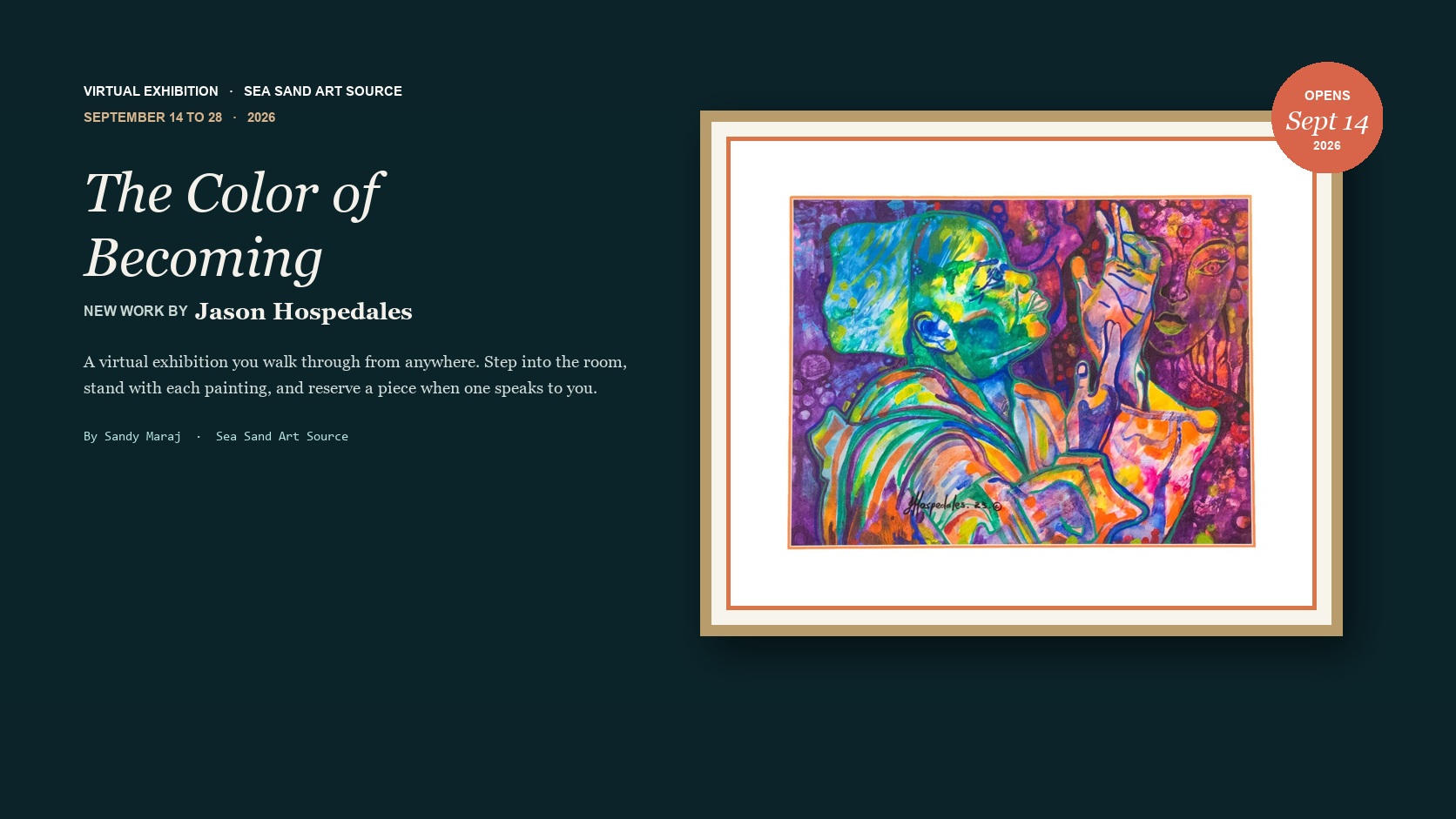
The Color of Becoming
A recent body of work, The Color of Becoming, is a deeply personal one for Jason. It came out of a period of self-healing, and the process of making it became inseparable from what the paintings are about.
Because he works on multiple pieces at once, the first painting he starts is rarely the first he finishes. In The Color of Becoming, that non-linear structure became the meaning of the work.
“Becoming, for me, is not a linear journey. It is a process of moving through layers, emotionally, spiritually, creatively, and psychologically.”
As the body of work developed, he felt a growing calm move through him. By the time he approached the final strokes of the final piece, he describes a profound stillness.
“That calmness became one of the most meaningful outcomes of the entire process. The work moved from vulnerability towards healing, from uncertainty towards clarity, and from simply creating images towards creating a space in which I could breathe, reflect, and continue becoming.”
The Color of Becoming opens as a private virtual exhibition running September 14 to 28, 2026, a two-week viewing available exclusively through seasandart.com. It is a walk-through virtual gallery: visitors move from painting to painting at their own pace, stand with a piece for as long as they like, and reserve any work that speaks to them. The exhibition is not hosted or listed anywhere else, so the only way to see it is through Sea Sand Art Source. As seen in The Color of Becoming, Jason Hospedales’ private virtual exhibition. Browse the collection and available works.
Trinidad, unapologetically
Jason’s work is unmistakably Caribbean, and specifically Trinidadian. That shows up in the obvious places (the phenotype and diversity of the people he depicts, the colours, the rhythm, the layered surfaces) and in the less obvious ones.
“Trinidad is a place shaped by extraordinary cultural diversity and complexity. Our people, traditions, spiritual practices, histories, languages, celebrations, and belief systems exist alongside one another in fascinating ways. That multifaceted character naturally finds its way into my work.”
The deepest Trinidadian mark on the paintings is the one you cannot photograph: a Caribbean way of engaging with the seen and the unseen, the recognition that the physical and spiritual worlds coexist and speak to each other. Even when he is painting a universal subject (love, healing, family, hope) he is looking at it through that specific cultural lens. It is what makes a Jason Hospedales painting feel spiritually plural in a way that Western contemporary painting often does not.
My Trinidad and Tobago
The Royal Caribbean mural is the most public commission of Jason’s career, but not the only one worth naming. He was also commissioned by Mr Joel Edwards, CEO of The Cyber Consulting Group Limited, to create a 6-by-4-foot painting titled My Trinidad and Tobago.
The brief was open. Edwards wanted a work that celebrated the many positive attributes of Trinidad and Tobago, and gave Jason the freedom to interpret that vision through his own visual language. Jason approached the commission the way he approaches every piece: by letting his personal iconography become the vehicle for the larger idea. The country’s diversity, its spiritual pluralism, and its layered histories all found their way onto the canvas through his vocabulary of prayer and symbol.
Beyond commissions, his practice continues to encompass exhibitions, teaching, sculpture, painting, and community engagement, all of it centred on the themes that have run through his work from the beginning: Caribbean identity, spirituality, family, heritage, transformation, and the human experience.
Where to start with a Jason Hospedales piece
If you are new to his work, the entry point is not the largest painting or the most expensive one. The entry point is any piece where you can sit with the surface long enough to see the layers Jason built on top of the initial abstraction after it had dried.
Look at the marks before the figures. Then look at the figures. Then look at what the two are saying to each other. That is when the prayer becomes visible.
See Jason Hospedales’ original work
Original works by Jason Hospedales are available at seasandart.com/jason-hospedales, alongside his current private viewing exhibition of The Color of Becoming. Each piece includes provenance, framing options, and shipping arrangements for buyers within Trinidad and internationally.
Sandy Maraj is the Founder and Director of Sea Sand Art Source, based in Port of Spain, Trinidad. With approximately 30 years of experience in custom framing, restoration, and Caribbean art, she has built longstanding relationships with artists across the region, including a close professional relationship with Jason Hospedales, whose work she has known and supported for many years.
Source note: interview conducted with Jason Hospedales, September 2026.